
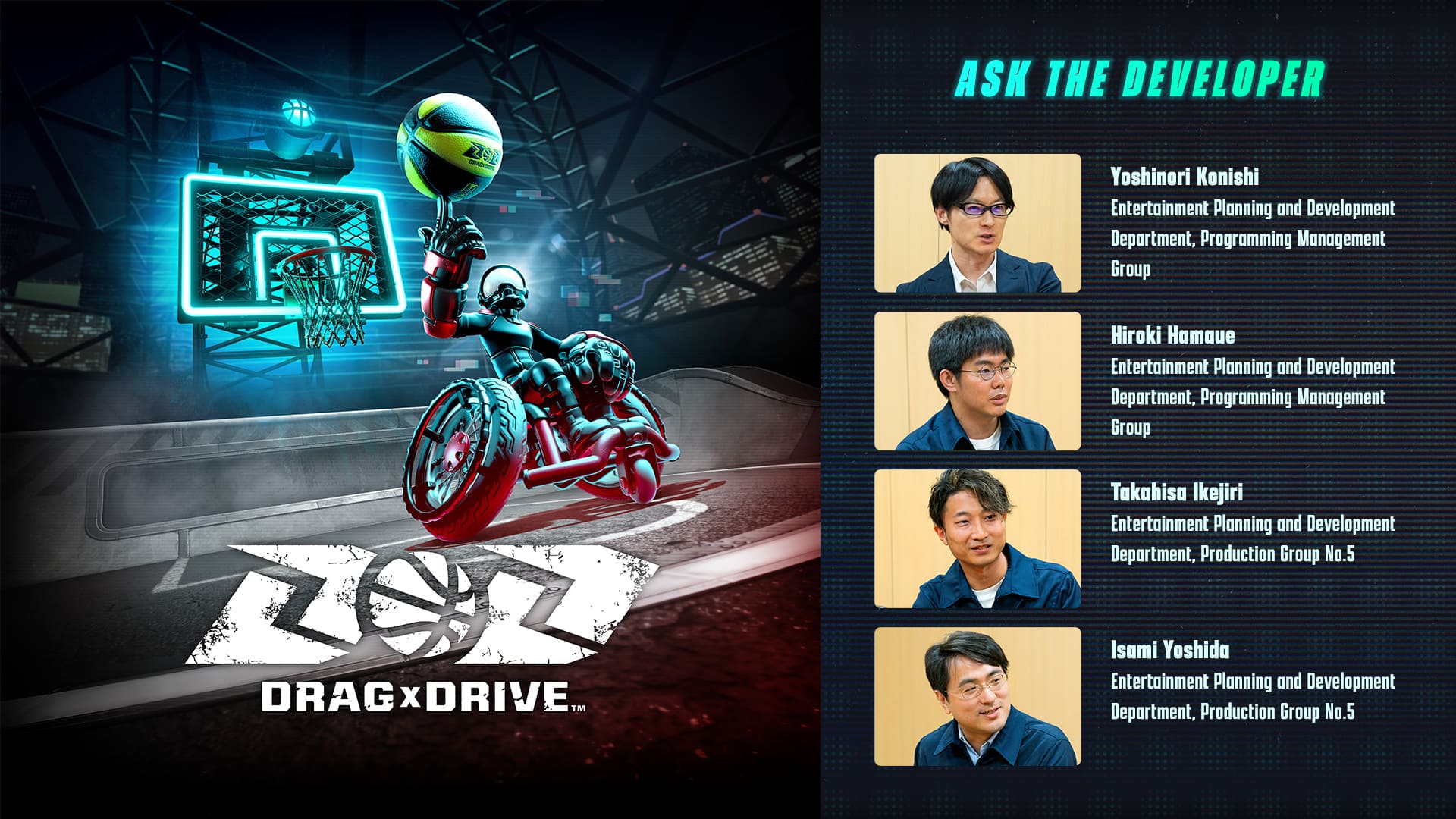
Ask the Developer Vol. 20: Drag x Drive — Part 3
This article has been translated from the original Japanese content.
In this 20th volume of Ask the Developer, an interview series in which developers convey in their own words Nintendo's thoughts about creating products and the unusual details they hone in on, we're talking to the developers behind Drag x Drive™, a Nintendo Switch™ 2 game that launched earlier this year, on Thursday, August 14.
Check out the rest of the interview
Part 3: Park vibes
You mentioned “bringing heat to the court” earlier. It sounds like you've emphasized capturing that street basketball vibe.
Konishi: That’s right. The park, which serves as the entry point for online play (10), was also inspired by street basketball. It consists of a court, where matches are played, and its surrounding environment and players.
(10) Nintendo Switch Online membership (sold separately) and Nintendo Account required for online features. Membership auto-renews after initial term at the then-current price unless canceled. Not available in all countries. Internet access required for online features. Terms apply.
I've heard the game features mini-games in addition to matches of up to 3-on-3. So, rather than splitting activities into separate modes, everything is brought together in a single space called the park, right?
Konishi: Correct. In street basketball, it's common for players who happen to be there that day to form teams on the spot and take turns playing. That kind of setup is known as a pickup game. When I learned about that, I thought it could work well with the matchmaking system we had in mind. In typical online play, matchmaking is based on players selecting the same mode or wanting to play the same match type. In this game, though, players first gather casually in the park, where they can play games, watch others, or practice on an open court. I think it has a lot in common with how street basketball works.
I see, so there's a single entry point for online play, and once players enter the park, they can decide what they want to do from there. You mentioned the street basketball vibe, but the court seems to have more of an underground feel than an open-air one. Is there a reason for this?
Konishi: In the early stages of development, the backdrop was more on the bright side. But during internal test play sessions, where we invited employees to try the game, we received quite a bit of feedback along the lines of “The ball's hard to see” or “I can’t tell where it is.” Many sports games use a top-down camera that shows the entire playing area, allowing players to see where the ball is and plan their actions accordingly. This means they rarely lose track of the ball. In this game, though, the ball often ends up outside the player’s screen.
I see. Since the camera is generally positioned behind the player, it's easy to lose sight of the ball when it goes to the side or behind them.
Konishi: Precisely. We did try using a top-down camera at one point, but it just didn't feel right. The sense of immersion was lost, and it made the gameplay feel less engaging. We thought to ourselves, “This isn’t the dynamic, hands-on control we were going for.” If we wanted players to feel as if they were controlling a wheelchair, we felt we had to go with a third-person view (11). However, the downside is that your field of vision becomes limited, which makes it easier to lose sight of the ball. To address this, we made the terrain dark and the ball yellow to create a strong visual contrast.
(11) A type of in-game camera perspective. The player can see the character they are controlling, usually from behind.
Yoshida: Even so, with a third-person view, you still can’t see the ball once it's gone behind you. So, we filled in the gaps with sound effects and music. For example, you might hear the ball hit the ground and think, “Ah, it landed behind me.”
Speaking of sound, once the background color and the overall vibe of the park were set, you started designing sound effects and music to match them, right?
Yoshida: Yes. When we heard the term “street basketball,” we began by exploring what kinds of music and sounds would feel right for that setting.
So, you aimed to capture the street basketball vibe through the sound design too?
Yoshida: We did a lot of research, which included watching matches of Japanese street basketball teams.
In one professional match, we noticed the background music shifting dramatically whenever there was a change of possession. We thought it might be interesting to incorporate that into our game. And it worked really well. The sudden change in music made it clear immediately that the ball had changed hands, even if it happened off-screen. It was a moment where a street basketball element fit perfectly into our game’s design.
So, the background music helped not only set the atmosphere, but also make the gameplay easier. What about the sound effects?
Yoshida: We placed a lot of importance on the ball’s sound effects. We made particular sound effects stand out, like the ball being stolen behind you or a pass being received, so players could easily follow the flow of the game. This title supports surround sound, so if you're playing with a compatible setup, it can sound as if the ball is really being stolen behind you. Also, when you're going for one of those dunk shots mentioned earlier, the background music and ambient sounds intentionally get quieter. From the moment you launch yourself from the half-pipe, the surrounding noise fades, and your focus narrows to the ball and the basket in front of you. We wanted to create a tense, breathless moment. Then, once you've made the dunk and the sound returns, you hear your teammates clapping. By using that kind of contrast, we were aiming to tie everything together into a more dramatic, unified production.
Speaking of which, in the park, you can hear sounds from events taking place further away.
Yoshida: Yes, that was something we really paid attention to. Having “park vibes” in mind, we wanted players to get a sense of what others in the park were doing through sound alone. Even if you can't tell exactly what's happening, you can still get a sense that someone's practicing shots or dashing across the court. We designed the sound so you can hear what's happening even from pretty far away.
So, the concept involves people gathering in the park around this new sport, inspired by wheelchair basketball, interacting with each other and enjoying themselves at their own pace. Were the “park vibes” you mentioned earlier something the whole team valued?
Konishi: Yes, I think the idea was put out there quite early. I loved going to parks as a child and often played there with classmates. Depending on the day, there might be older or younger kids around, and what we played would change based on who happened to be there and how many of us there were. We might start out with just a few friends playing catch, but as more people showed up, we’d switch to dodgeball or tag. That kind of atmosphere was something the whole team could relate to, and it tied in nicely with the pickup game concept, so “park vibes” became something we all valued.

While there isn't any verbal communication in this game, players can still communicate by waving or clapping. Was that a conscious decision from the start?
Ikejiri: Yes, it was. We implemented what we call a motion-sync system, which maps gestures made with the Joy-Con 2 controllers, such as waving, to in-game actions. This enables simple forms of communication like high-fives and clapping. We deliberately left out verbal communication because we wanted players to experience the unique kind of interaction made possible by analog motion controls. We believe that gestures alone can often convey emotion more clearly and instinctively than words.
Speaking of communication, you can also use GameChat (12) while playing online on Nintendo Switch 2.
Ikejiri: Players move about lots during gameplay, so it’s fun to see their movements appear on screen via the camera (13) in GameChat. Earlier, I mentioned that we left out verbal communication, but I think using GameChat for advanced coordination is another way to enjoy it.
(12) Internet, Nintendo Switch Online membership and Nintendo Account required for online features, including GameChat. Compatible USB camera required for video features. Not available in all countries. Terms and GameChat requirements apply. support.nintendo.com. Games, systems, memberships and some accessories sold separately. Until March 31, 2026, GameChat can be used without a Nintendo Switch Online membership. Afterwards, a Nintendo Switch Online membership will be required to use GameChat.
(13) A compatible USB camera, such as the Nintendo Switch 2 camera (sold separately), is required for video features.
Konishi: You can have strategic conversations during a game, like, “I’m going for a three-pointer” or “Mark that player.”
Ikejiri: There are also little diversions like jump rope and sumo, so if you need a break from matches, you can hang out with friends and play something else.
I see. With such a broad scope of communication, it sounds like there are various ways for players to approach the game. To close, may I ask each of you to share a brief message?
Yoshida: I'm atrocious at sports. (Laughs) Especially ball games, and I don't fare much better in video games. Even so, the more I played this game, the more I felt that even someone like me can find a role that fits them. For example, if the other team scores, I grab the ball and pass it to a teammate further down the court. Pulling off precise moves in offense is definitely satisfying, but this game offers lots of alternative ways to play. I hope people who don't think of themselves as sporty will give it a try. The sound team worked hard to ensure the sound effects convey the thrill of successfully landing tricks and techniques, and we hope players will enjoy this game through the sound.
Ikejiri: As designers, we focused on making sure the controls felt intuitive and responsive. Something I personally want to call out is the motion sync system that lets players raise their arms to clap and praise others or exchange high-fives. I feel like we’ve created a form of interaction that’s unique to this game. I'm sure you’ll make all sorts of discoveries once you get your hands on it, so please give it a try.
Hamaue: My focus, which ties into what Ikejiri-san said, was making sure the game responds closely to how players move, from a programming perspective. For instance, even if a player’s name isn’t displayed and you can’t tell who’s controlling a character, their movements are reflected so clearly that you might think to yourself, “Is that so-and-so?” just from a quick glance. This game offers a fresh experience made possible by the Joy-Con 2 controllers, so if you're into trying out new things or gadgets, I’d love for you to check it out.

Konishi: Back in April 2025, there was a hands-on event for Switch 2, and I had the chance to watch people playing Drag x Drive at our booths. There was a pair of visitors who played exceptionally well, so I spoke with them afterward. One of them was reportedly good at action games, while the other claimed to be bad at them. So, I asked the second person, “How are you doing so well even though you're supposedly bad at action games?” and they replied, “Maybe because I use a mouse every day at work?” Hearing that made me realize just how much potential this game has.
Of course, it’s great for people who enjoy action games or being physically active, but we especially want those who aren’t as confident in video games or sports to join in and have fun. In fact, you might discover a hidden talent and surprise yourself with how well you take to the controls. We recently released a free demo of this game, where you can play offline matches against bots, so I hope you'll download it and check it out.
I see, so with a completely new control scheme that only Switch 2 can offer, everyone gets to start fresh. I look forward to visiting the park! Thank you very much.
