
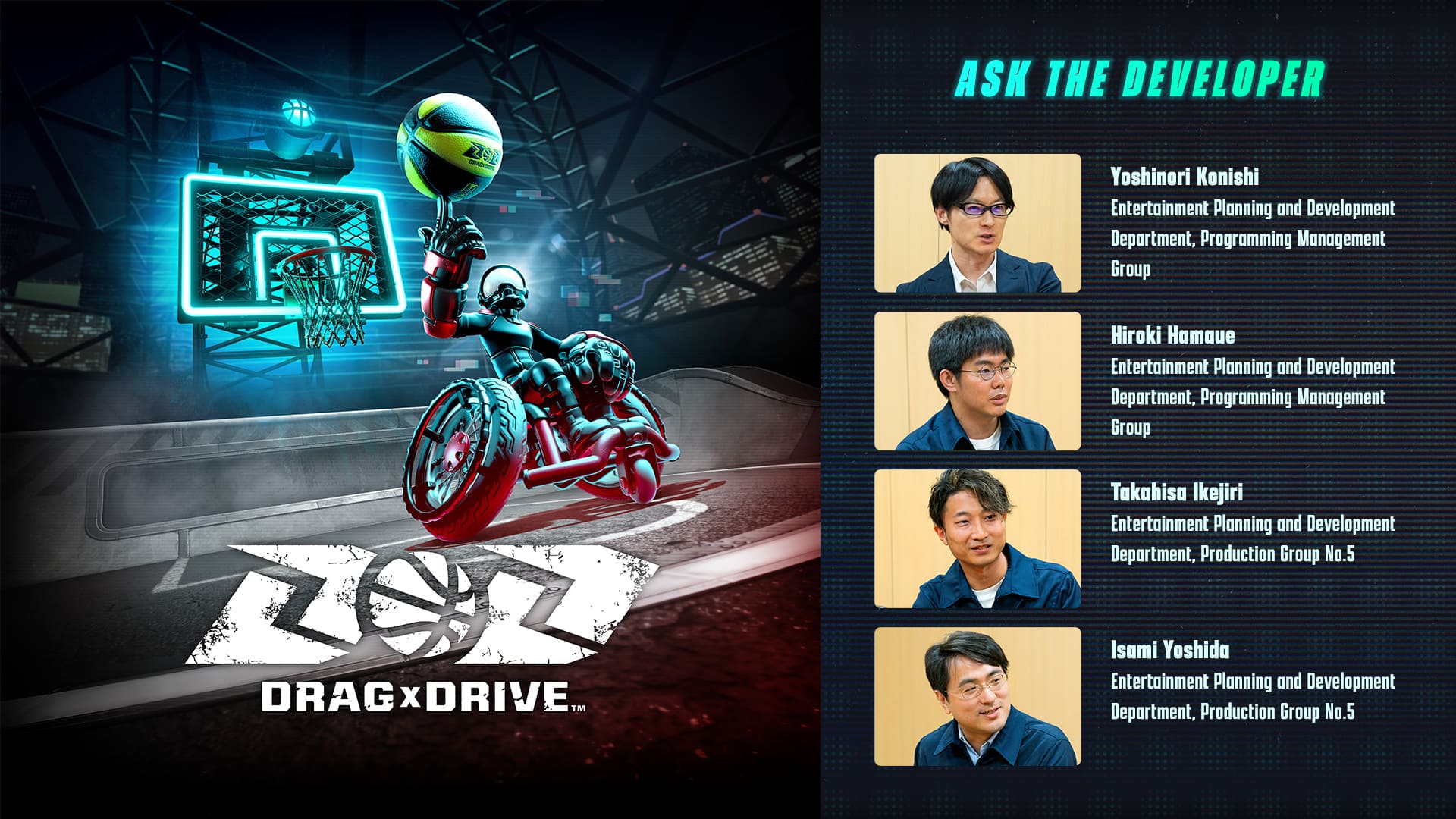
Ask the Developer Vol. 20: Drag x Drive — Part 1
This article has been translated from the original Japanese content.
In this 20th volume of Ask the Developer, an interview series in which developers convey in their own words Nintendo's thoughts about creating products and the unusual details they hone in on, we're talking to the developers behind Drag x Drive™, a Nintendo Switch™ 2 game that launched earlier this year, on Thursday, August 14.
Check out the rest of the interview
Part 1: Develop and drive
First, can you introduce yourselves?
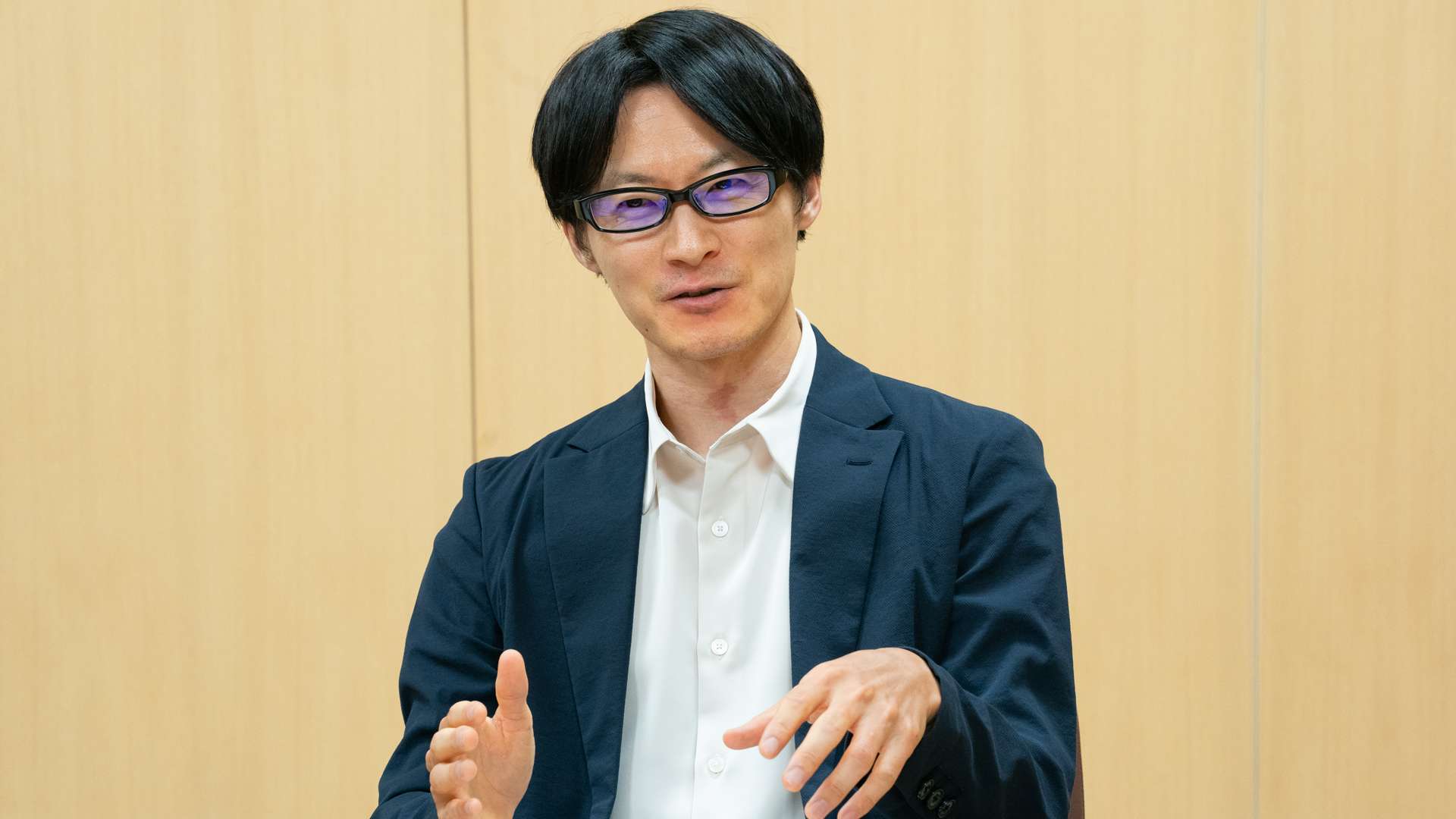
Yoshinori Konishi (referred to as Konishi from this point on): Hello, I’m Yoshinori Konishi, the director for Drag x Drive. Previously, I was involved in the Mario Kart™ series (1) and Wii Fit™ Plus (2) as a programmer and programming director. As both the director and programming director for Drag x Drive, I was involved in development from a feature and technical point of view.
(1) A video game series that began with the Super Nintendo Entertainment System title, Super Mario Kart, released in September 1992 in North America. Characters from the Mario series race and battle through a variety of courses.
(2) A Wii™ game released in October 2009. Using the Wii Balance Board, a total of 69 fitness-based activities can be enjoyed, including strength training and yoga.
Hiroki Hamaue (referred to as Hamaue from this point on): Hello, I’m Hiroki Hamaue, one of the programmers who worked on Drag x Drive. I programmed the player character’s movements, Joy-Con 2 controller mouse controls, and HD rumble 2. I was a programmer on past titles such as Ring Fit Adventure (3) and Nintendo Switch™ Sports (4). I love both developing and playing games that get your body moving. (Laughs)
(3) A Nintendo Switch™ game released in October 2019. In this fitness adventure game, you play by attaching Joy-Con™ controllers to the Ring-Con™ and Leg-Strap accessories that come with the software and moving your entire body.
(4) A Nintendo Switch game released in April 2022. With intuitive controls using the Joy-Con controller, a total of eight sports can be played, including Bowling, Chambara, and Soccer.
Takahisa Ikejiri (referred to as Ikejiri from this point on): Hello, I’m Takahisa Ikejiri, one of the designers who worked on the game. I was previously involved in the character design for the Splatoon™ series (5) and Super Mario Bros.™ Wonder (6). For Drag x Drive, I was responsible for the art direction and character design.
(5) A game series that began with the Wii U™ game Splatoon, released in May 2015. Mysterious squids who can change into human form battle to claim turf using ink.
(6) A Nintendo Switch game released in October 2023. In this 2D side-scrolling platformer set in the Flower Kingdom, players overcome enemies and obstacles as they head for the goal pole. Collecting a Wonder Flower triggers changes in the course and gameplay.
Isami Yoshida (referred to as Yoshida from this point on): Hello, I’m Isami Yoshida, the sound designer. I’ve previously worked on the sound effects for games such as the Splatoon 3: Expansion Pass – Wave 2: Side Order DLC (7) and The Legend of Zelda™: Tears of the Kingdom (8). While working on the sound effects for Drag x Drive, I also discussed the background music direction with the composers and how each sound plays in the game world.
(7) A second wave of the Expansion Pass DLC for the Nintendo Switch game Splatoon 3 (originally released in September 2022), made available in February 2024. In this single-player campaign set in the Spire of Order, players expand their abilities with power-ups called color chips as they conquer various floors to reach the top of the Spire of Order.
(8) The Legend of Zelda: Tears of the Kingdom, a Nintendo Switch game released in May 2023. It takes place after the story of the Legend of Zelda: Breath of the Wild game and is set in the same world. The title explores a vast environment across the land and skies of Hyrule. Players can pick up, move, and fuse together many objects to create things like vehicles and weapons.
Thank you very much. Konishi-san, please could I ask you to give us a brief introduction to this game?
Konishi: Yes, of course. Drag x Drive is a new style of sports game that you play intuitively by moving the two Joy-Con 2 controllers like mice. It's inspired by sports such as wheelchair basketball, wheelchair rugby, wheelchair motocross, BMX and skateboarding. Players maneuver wheelchair-like vehicles as they compete in matches of up to 3-on-3.
The unique gameplay using mouse controls showcased in the overview trailer left a strong impression on me. Where did you get the idea for this gameplay?
Konishi: The game originated from a prototyping team formed to create something new. The purpose of this team was for members from diverse disciplines to come together and freely create new kinds of gameplay, not restricted to a particular genre, hardware or feature. I had a manager-like role in that team. With the intent of gaining experience, we gathered up team members who were relatively new to the company and experimented every day. As we tested out lots of different ideas, one that particularly stood out was a gameplay mechanic created by Hamaue-san, which involved using mouse controls to move the wheels of a wheelchair.
I see. Hamaue-san, were you experimenting with mouse controls from the beginning?
Hamaue: It was about two years ago when I was prototyping. I'd heard that the controller for our next gaming console would have mouse functionality. Combine that with motion controls, I thought, and I could create a completely new control experience using mice. So, I played around with various control schemes. But mouse controls are an established thing, so I kept replacing various inputs with mouse controls to try and inject some originality into the control scheme.
Replacing various inputs with mouse controls?
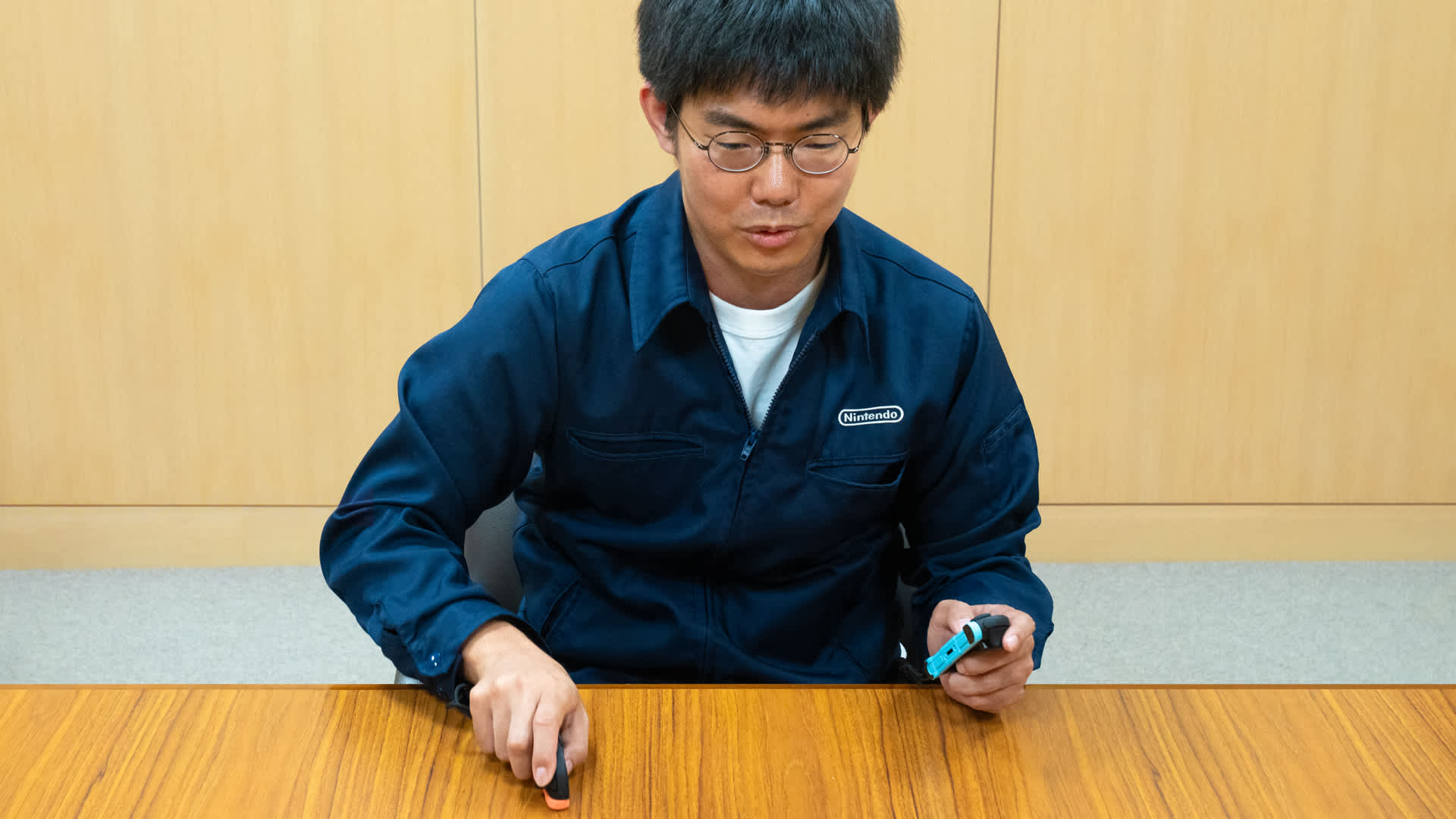
Hamaue: That's right. A familiar comparison would be the flick gesture you make when scrolling on a smartphone. Flicking a smartphone's touchscreen is satisfying, and I was wondering if I could achieve the same with mouse controls. That's just one of the avenues I was exploring. During such experiments, I discovered that sliding the mouse had the potential to become a new control method requiring large body movements.
Konishi: We then tried using this sliding motion to create various gameplay mechanics, right? Like the chainsaw.
Hamaue: Right. The chainsaw gameplay, where you start the motor by pulling the mouse towards you vigorously and use a swinging motion to cut through things, was received very positively by the team. So, we decided to experiment a bit further with this single-axis, vertical sliding movement.
So, you thought it had potential after seeing the team’s reaction. Could you elaborate a bit on this “single-axis movement”?
Hamaue: To explore the possibilities of mouse controls, we played prototypes of various games that used, for example, one mouse in each hand, or combined mouse actions with control stick movements and button presses. During this process, we realized it was too demanding to move freely in any direction with both hands while simultaneously using the control stick and buttons. So, we pruned back the difficult actions, leaving only the satisfying ones, and we were left with the single-axis movement of sliding the mouse back and forth. Combining everything, including control stick and button controls, would have expanded the gameplay possibilities, but some team members remarked that humans aren't quite there yet, as a species. (Laughs)
Everyone: (Laughs)
Hamaue: We also experimented with combining mouse controls and HD rumble 2. We discovered that by adding a rattling vibration in sync with mouse movements, it felt like you were actually turning a wheel. We tried pairing this with sliding the mice back and forth with both hands, just to see what would happen. That's when we realized, “Hey, this feels a bit like maneuvering a wheelchair.” I'd experienced riding a wheelchair for a research project back when I was a student, and it reminded me of that. So, I created a gameplay mechanic where you control the wheels of a wheelchair, like this.
Konishi: This caught the attention of the producers, and I was asked to turn it into a sports game. We decided to prototype a little further to expand the possibilities of this gameplay mechanic. There were lots of ideas from various people, but I remember this being one in particular where lots of people said, “I want to try it out!” At that point, the wheelchair was quite difficult to control, as it didn't go in a straight line or moved about too quickly. However, from our experience implementing controls during the development of the Mario Kart series, I thought we could solve it on the system software side, and I wanted to expand on this idea with Hamaue-san.
Now I understand how this project came about. I suppose the next step was to finally shape this idea into a sports game, right? The game seems to have been inspired by wheelchair basketball. How did you get to that point?
Hamaue: The producers were saying, “It might be interesting to theme it around basketball." I was previously involved in the development of Nintendo Switch Sports, so I wondered if I could combine shaking the Joy-Con 2 controllers with mouse controls. The theme caught my imagination, since wheelchair movement meant sliding the Joy-Con 2 controllers like mice, while the basketball element meant flicking the controller to throw the ball, both of which involve hand movements.
Konishi: If we went with basketball, all you'd have to do is move under the basket and flick the Joy-Con 2 controller forward to shoot. I thought we could strike a good balance, where moving requires a bit of practice, but shooting isn’t all that difficult. However, given how the wheelchair was controlling at the time, I didn't think it was ready to be turned into a sports game just yet. So, we iterated on it together for about two months. I’d write the specs, and Hamaue-san would implement them.
It looks like it would take some ingenuity to get the wheelchair controlling like you'd expect. How did that go?
Konishi: Well, first we had to get it moving in a straight line. The prototype at the time reflected the mouse input directly in the movement of the wheels. You could feel like you’re propelling yourself in a straight line, but in fact, you might be putting more force into one hand, or sliding diagonally depending on your dominant hand. This would cause the mouse input to have slightly different values on each side, and you’d end up accidentally turning, making it tough to move in a straight line. So, the first thing I did was to ask Hamaue-san to implement a “straightness correction” so that players could move in their intended direction. This makes it easier to move straight forward by aligning the rotation of both wheels when it detects that the left and right mice are inputting forward to a certain degree.
So, you bridged the gap between how players expect the wheels to move and how they move in the game.
Konishi: We took another two to three weeks to fine-tune the controls for moving in a straight line and turning. From there, we experimented to see what kinds of rules would make the game more interesting. One idea that came out of this was tackling.
Tackling in wheelchair basketball?
Hamaue: When we tested out racing with traffic cones placed around the game's course, we got more enjoyment and satisfaction out of crashing into the cones than avoiding them. So, we tried creating a movement where the player heads right for the opponent, like in a football tackle. Then, the designers created a sumo wrestling ring for the action to take place in, and gameplay based on tackling the opponent and pushing them out the ring was born.
Konishi: Of course, tackling isn't allowed in actual wheelchair basketball, but having the characters dribble while maneuvering the wheelchair would have made it too easy for other players to steal the ball. So, we decided to test and implement a wheelchair rugby-like mechanic where the player loses the ball when tackled. We kept the movements simple: no dribbling, tackle to steal the ball, and once you’re under the basket, flick your wrist forward to shoot. This made it much easier to play, as you can focus on the main action, which is maneuvering the vehicle with mouse controls.
So, you narrowed your focus to intuitive mouse controls. Speaking of which, apart from Hamaue-san's experience you mentioned earlier, did anyone on the development team have first-hand experience using a wheelchair?
Konishi: No one on the team had used a wheelchair on a daily basis, so we began by gathering up reading materials so we could learn more about it. From an encyclopedia of wheelchairs to videos and essays by wheelchair athletes and even manga about basketball or wheelchairs, we pulled together as much reference material as we could lay our hands on and studied it together. Also, in order to gain hands-on experience, we bought an everyday wheelchair and a sports wheelchair for the office so we could develop and drive at the same time. We compared the two wheelchairs and realized that the sports wheelchair has angled wheels, allowing for stable turning. However, since it was being developed for Nintendo Switch 2, which wasn’t announced at the time, it was a highly confidential project. So, we were restricted to the small space inside the office and could only let loose down the hallway once everyone else had gone home for the day. (Laughs) Besides that, we also joined a wheelchair basketball experience event as a team.
Oh, did you get the chance to try out wheelchair basketball for yourselves?
Konishi: We did indeed. A wheelchair basketball game was held in Osaka around the same time, and we had the opportunity to take part in a trial session after the match.
Ikejiri: I wasn't prepared for how difficult it was to shoot the ball. In wheelchair basketball, the hoop is placed at the same height as in standard basketball. But since you take the shot sitting down, my shot didn't reach the basket at all.
Hamaue: Maneuvering a wheelchair is difficult unless you get the hang of when to apply and release force. You can't just propel yourself along smoothly in a single stroke. But it cemented for me how deep the controls are, as you propel both wheels at full speed or put force into just one wheel to make a sharp turn. I thought that if we could authentically recreate the feeling of propelling a wheelchair and pursue a sense of realism, it would make for an interesting motion-based game.
Ikejiri: We wanted players simply to enjoy the intuitive controls, so to make maneuvering the vehicle feel responsive, we emphasized the arms and wheels in the designs. We kept everything else as simple as possible without cramming in too many elements.
By the way, besides the development team getting to experience wheelchair basketball, I heard that real-life wheelchair basketball players also got the chance to try out the prototype.
Konishi: That’s right. We were partway through development when we received this golden opportunity.
Because the players use wheelchairs in their daily lives, they were all really good at turning and moving backwards in the game. Of course, we learned a lot about the controls, but we gained even more insights watching them think about what to do on the court as they played. It differs from wheelchair basketball in lots of respects: there's a half-pipe below the goal, no dribbling, and players tackle their opponent to steal the ball. Nevertheless, they seemed to accept those differences naturally and enjoyed playing the game.
Hamaue: Seeing actual wheelchair basketball players get the hang of the game and its controls so quickly confirmed to us that it could work well as an intuitive control scheme. Above all, seeing everyone genuinely enjoying the game gave us confidence as developers that we were headed in the right direction.
Konishi: We were also thankful for how delighted they all were that such a game was being developed, saying that it has the potential to shine a spotlight on wheelchair basketball. I was really happy to hear that.
Read more in Part 2: Three challenges, one solution